In this edition of spotlight on graduate student research we showcase four students working at CENPA, our Center for Nuclear Physics and Astrophysics. CENPA is a laboratory with a broad range of experiments, with a common thread of precision measurements in search for physics beyond the standard model.
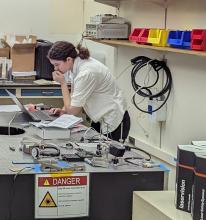
Shoshana Apple is a member of the Eöt-Wash lab in CENPA, which focuses on gravitational physics where she primarily works on developing instrumentation for the LIGO gravitational wave detectors. Specifically, her research focuses on developing inertial rotation sensors for the LIGO seismic isolation system, which is necessary in order to keep the LIGO mirrors as still as possible to allow them to detect the fluctuations in space-time from gravitational waves. A sensor with picoradian sensitivity is planned to be installed in the detector later this year, and will directly measure the rotation of the platform from which the LIGO mirrors are suspended. Additionally, Shoshana works on the mitigation of Newtonian Noise (excess motion of the mirrors due to tiny fluctuations in the local gravitational field) for both LIGO and next generation gravitational wave detectors. She will be spending this summer at the Hanford LIGO site in order to install and test a rotation sensor to measure the passing seismic waves which are predicted to be the main source of Newtonian Noise.
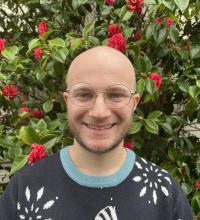
CJ Nave is a 6th year grad student working on characterizing germanium detectors for the LEGEND experiment. LEGEND is searching for a proposed rare nuclear decay known as neutrinoless double beta decay. Discovery of this decay would have a massive impact on our understanding of physics, ranging from the matter-antimatter asymmetry of the Universe to the strange nature of the neutrino and the symmetries of the Standard Model. CJ’s research focuses on studying the germanium detectors that LEGEND uses in its rare event search. These detectors are very effective gamma spectroscopy technologies, but they still have some behaviors that are not well understood. One such behavior is their susceptibility to free charges building up on detector surfaces, generating inactive regions inside detectors. CJ runs a germanium test-stand at CENPA and aims to characterize these inactive detector regions through data and simulation. The simulated surface charge model recreates some of the data very well, but there is much variability in the data which is not yet fully resolved.
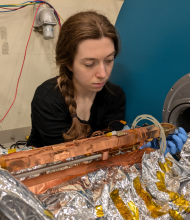
Heather Harrington has spent the last 7 years commissioning the He6-CRES experiment with the goal of interrogating the V-AV structure of the weak interaction. He6-CRES uses Cyclotron Radiation Emission Spectroscopy to precisely measure the kinetic energy of charged particles via the cyclotron radiation they produce as they orbit in a magnetic field, containing and transmitting these microwaves in waveguides, and detecting the onset of O(fW) signals when a beta is produced by a nuclear decay. As the detection efficiency is charge-symmetric, but BSM non V-AV effective couplings would cause opposite signs in a m/E distortion to beta+ and beta- spectra, this technique may be used to cancel energy-dependant detection efficiencies while enhancing the BSM sensitivity in the ratio of beta+ and beta- spectra. He6-CRES currently uses the decays of 19Ne and 6He, produced using the FT-Tandem Accelerator at CENPA, to do precisely this. Extending the CRES technique to do broad-band beta spectroscopy has required overcoming many technical challenges. In her time in the group, Heather has executed many hardware projects from vacuum and gas handling systems, to rigorous characterization of an auxiliary SiPM detector, to RF diagnostics and upgrades. She has been lead for event reconstruction, magnetic mapping, and several data taking campaigns and systematic studies.
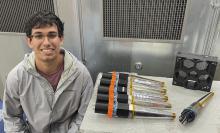
Omar Beesley is a 5th-year graduate student working at CENPA with Professor David Hertzog on the PIONEER rare pion decay experiment. In its first phase, PIONEER will provide the most sensitive test of lepton flavor universality to date. In later phases, the experiment will measure pion beta decay to extract the CKM matrix element Vud to probe the Cabibbo Angle Anomaly. During his time at UW, Omar has led the development of a LYSO crystal calorimeter for PIONEER. The crystal scintillators that compose the calorimeter provide precise timing and energy information in response to pion decay products, which reconstruction algorithms then use to distinguish between pion decay channels. Over the past year, he has taken a leading role in developing AI models capable of reconstructing the complex event topologies found across PIONEER's various detector subsystems. His current work focuses on a unified, transformer-based architecture that integrates detector data from all detector subsystems to perform a holistic event reconstruction.